Line Set Guide · 2026
If you're researching MRCOOL DIY mini split systems, chances are you've landed on the topic of pre-charged quick connect line sets. Here's everything you need to know about the official MRCOOL options, how they work, and why Zone Air deserves a close look before you commit.
A MRCOOL DIY pre-charged quick connect line set is a pair of copper refrigerant lines factory-filled with R-454B, sealed at both ends with spring-loaded valves, and ready to connect between your indoor unit and outdoor condenser without gauges, brazing, or a vacuum pump. These are official MRCOOL DIY Quick Connect / No-Vac line sets built specifically for MRCOOL DIY 5th Gen systems — not generic flared line sets you'd find at a supply house.
The MRCOOL DIY mini split is a ductless heating and cooling system designed for easy installation by homeowners. Its pre-charged line sets eliminate the need for vacuuming, meaning DIY-friendly systems do not require specialized HVAC tools or professional training. Zone Air pre-charged line sets follow the same no-vac philosophy, shipping with every system kit.
How It Works
Each end of the line set carries a patented spring-loaded valve sealed under a protective cap. Factory-charged copper tubing arrives pressurized with R-454B, and the valves stay closed until you fully seat the fittings.
Quick connect lines simplify the installation process of mini-split systems — they connect in minutes with zero hassle compared to traditional HVAC installations, which require cutting, brazing, and vacuuming. Remove the caps, align the male and female quick connect fittings, hand-tighten, then torque to the spec listed in the manual. Once fully seated, the spring valves open and refrigerant flows between the outdoor and indoor unit.
Each end carries a patented spring-loaded valve sealed under a protective cap, holding the factory R-454B charge until the fitting is fully seated. Remove caps, align the fittings, hand-tighten, then torque to the manual's spec — the valves open and refrigerant flows. No gauges, no brazing, no vacuum pump.
MRCOOL engaged 360° Product Testing to validate the design. Pre-charged line sets are tested for leak resistance at 400 PSI for at least eight hours, and the couplers pass a pull test exceeding 500 lb of force.
Line sets include a UV-protective insulation sleeve for durability, and kink-resistant line designs make installation easier and prevent damage during routing. Longer SKUs (35 ft and 50 ft) bundle a DIY Pro Cable for the communication wire between units.
Compatibility
MRCOOL DIY Quick Connect pre-charged line sets are only compatible with MRCOOL DIY series Quick Connect ports. You cannot use them on standard flare-type ports, MRCOOL Universal models, or other brands.
Zone Air pre-charged line sets are similarly dedicated to Zone Air ports, so buyers must stay within one ecosystem. Cross-compatibility does not exist between brands.
SKUs & Accessories
Official MRCOOL DIY pre-charged Quick Connect line sets ship in fixed lengths of 16, 25, 35, and 50 feet across three diameter pairings. The right choice comes down to your floor plan and the BTU capacity of your system.
| Line Set | Diameter | Best For |
|---|---|---|
| 16 ft · DIY16-1438-O | 1/4" x 3/8" | Close-coupled 6K–12K wall-mounted installs where the condenser sits just outside the room |
| 25 ft · DIY25-3858-O | 3/8" x 5/8" | The standard run for 24K and 36K units. Expect roughly $450–$500 for this line set alone |
| 35 / 50 ft · "C" SKUs | Various | Longer runs (e.g. DIY35-1438C-O, DIY50-3858C-O). The "C" suffix means the communication wire is included |
Installation
Installation can be completed in just a few hours by a moderately handy homeowner, and no HVAC license is required thanks to the pre-charged design. Still, follow the MRCOOL manual step by step for your specific 5th Gen system.
Plan the line set path and total length before drilling. Account for vertical rise, bends, and whether you need couplers or LineGuard covers.
Drill an appropriately sized wall penetration with a slight downward slope toward the outside to prevent condensate backflow.
Carefully uncoil and route the insulated line without kinking the copper, especially on the larger 3/8" or 5/8" sections.
Remove caps, align the quick connect fittings, hand-tighten, then torque with wrenches to the manufacturer spec.
Connect the outdoor unit the same way. Double-check that valves are fully seated before proceeding.
Open the service valves on the condenser, power up the system, and run a leak check following the startup procedure in your manual.
Never cut, re-flare, or attempt to recover refrigerant from pre-charged lines. Doing so voids the no-vac design and may violate EPA Section 608 rules, since R-454B carries an A2L (mildly flammable) classification that demands safety precautions. In cold climates, protect exposed line sets from snow, ice, and UV with covers, and secure them to prevent wind movement.
Zone Air systems use a similar pre-charged, DIY-friendly workflow optimized around high-efficiency kits reaching up to 24 SEER2.
Comparison
MRCOOL popularized the DIY pre-charged mini split concept in North America, but homeowners now have newer alternatives. Zone Air uses the same no-vac approach with a few key differences worth weighing.
Both brands offer pre-charged line sets with quick-connect style fittings, so homeowners save by avoiding vacuum pumps, refrigerant handling, and contractor labor. DIY mini split systems can save $3,000–$5,000 in installation costs with either brand.
SEER2 ratings measure cooling energy efficiency — higher ratings mean lower energy consumption over the life of the system. Zone Air systems achieve up to 24 SEER2 with Energy Star and cold-climate certifications, which is where efficiency pays off most over time.
MRCOOL offers many line set SKUs (1/4" x 3/8", 1/4" x 1/2", 3/8" x 5/8") across four lengths. Zone Air keeps a tighter catalog — every kit ships with a 16 ft pre-charged line set, and extensions (9 ft or 33 ft) bring the total to about 25 or 49.5 ft. Fewer SKUs mean less chance of ordering errors.
Zone Air offers a 7-year compressor warranty, 5-year parts warranty, and a 45-day satisfaction guarantee with free shipping and live US-based tech support.
Homeowners can receive rebates for installing energy-efficient mini-split systems. Zone Air's cold-climate models, running down to -13°F, are designed with rebate eligibility in mind.
DIY mini-split systems can heat and cool up to 1,500 sq ft, making them viable whole-room or whole-zone solutions for either brand.
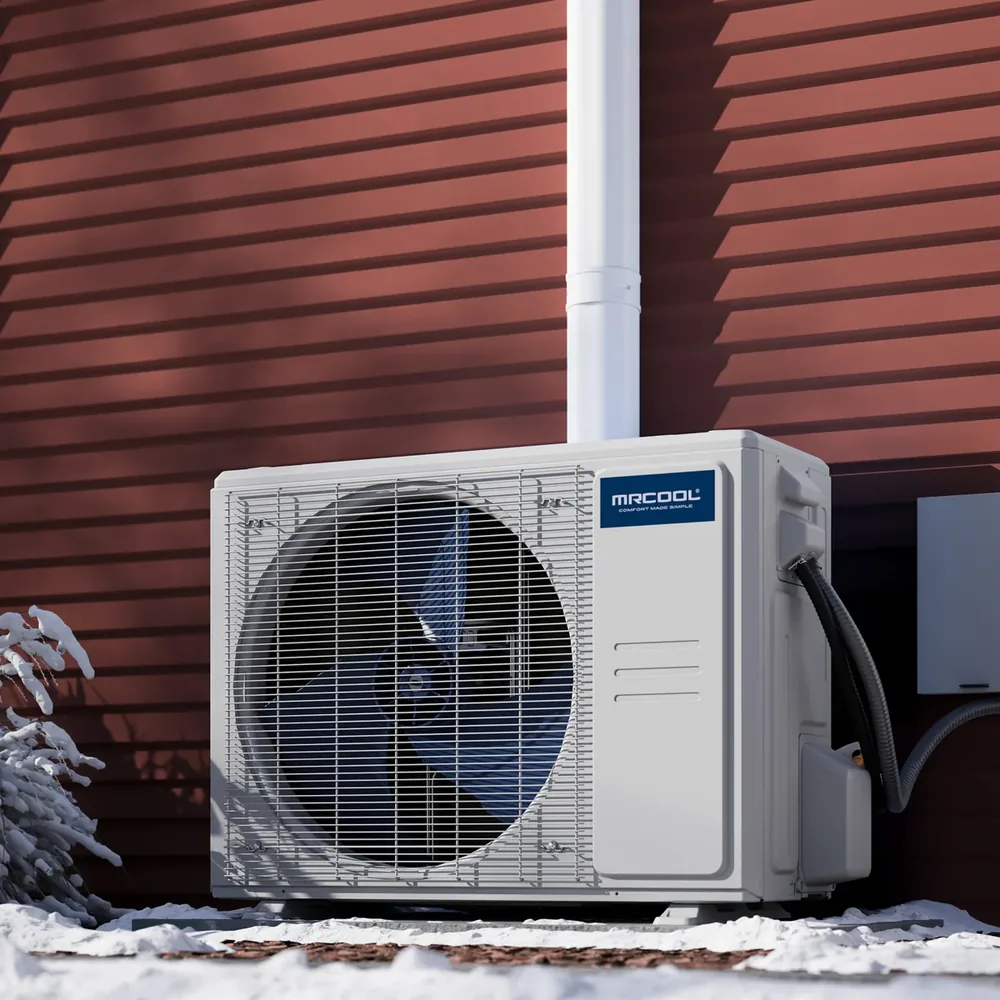
If you already own a MRCOOL DIY system, you must buy official MRCOOL line sets. If you're still shopping, compare full-system cost, efficiency, and support between MRCOOL and a Zone Air kit before you commit.
Buying Decision
Picking the correct system and line set comes down to three decisions: BTU capacity, line set diameter, and line set length. Get these right and the rest of the install falls into place.
If you've already committed to MRCOOL DIY, select the correct official line set by diameter and length. If you're still researching, explore a Zone Air mini split package with pre-charged line sets, WiFi control, and guided DIY support — it may be the simpler, higher-value path.
About the Author
Homeowners & hands-on installers
We're homeowners who've installed pre-charged ductless systems in our own additions, garages, and bonus rooms — not contractors selling a service. This guide draws on hands-on experience routing quick-connect line sets, official MRCOOL DIY documentation, and product testing data to give you a straight answer on what fits your system. Our goal is simple: help you order the right line set the first time and finish your install in a weekend. We work closely with Zone Air to stay current on no-vac line set design, cold-climate performance, and rebate eligibility for DIY-friendly systems.
Keep Reading
Our full ranking of the top mini split systems — efficiency, cold-climate performance, warranty, and the best DIY pick.
See the rankings →Compare Zone Air, MrCool, Pioneer, and Senville on efficiency, warranty, and install difficulty.
Read the guide →Compare the top DIY mini split brands side-by-side, or read our full installation guide to plan your line set routing.