MRCOOL DIY 4th Gen Review: Is It Still Worth It in 2026?
This mrcool diy 4th gen review looks at whether the once-leading DIY mini split still makes sense today. The short answer: it can work well, but newer systems now offer better efficiency, stronger cold-weather heat, and cleaner support.
Quick Verdict
Quick Verdict on the MRCOOL DIY 4th Gen
The MRCOOL DIY 4th Gen ductless mini split was a breakthrough for homeowners around 2020–2023. It made easy installation possible with a pre charged line set, quick connect fittings, and no vacuum pump.
By 2026, the 4th Gen is still a proven system, but it has fallen behind newer choices like Zone Air, which uses USA-based assembly, inspection, and testing for more consistent quality.
Category
MRCOOL DIY 4th Gen
Zone Air
Efficiency
Often around 20–22 SEER; the MRCOOL DIY heat pump has a 20.5 SEER rating on common models
Do it yourself, no vacuum pump high efficiency systems can achieve up to 24 SEER2
Cold performance
Standard models are less confident below 0°F
Cold climate certification is important for efficient heating in colder regions, and Zone Air is designed for stronger low-ambient performance
Warranty
Often 5-year parts and 7-year compressor with registration
5-year parts, 7-year compressor, and USA-based support
Quality control
Overseas manufacturing focus
USA-based assembly, inspection, and testing
MRCOOL has shifted attention to 5th Gen and newer models; the MRCOOL DIY 5th Gen has a SEER2 rating of 23.9, and the MRCOOL DIY 5th Gen system has a SEER2 rating of 23.9. The MRCOOL DIY 5th Gen includes a 7-year compressor warranty.
Before you add remaining 4th Gen inventory to cart, check the product page, quantity, and even controls like decrease quantity so you know what size and refrigerant you are buying. If you click through closeout stock, MRCOOL DIY 4th Gen can save money at a discount, but for rebates, comfort, and longer reliability, Zone Air is usually the smarter option.
Overview
Overview of the MRCOOL DIY 4th Gen System
The mrcool diy 4th gen is a pre-charged ductless mini split heat pump designed for homeowners to install without an HVAC license. DIY heat pumps require no HVAC license for installation, and MRCOOL DIY systems require no HVAC license for installation.
Popular sizes included 12,000 btu, 18,000 btu, and 24,000 btu single-zone units. Heat pumps can heat and cool spaces up to 1,000 sq. ft., and MRCOOL DIY systems can heat and cool spaces up to 1,000 sq. ft. For example, a 24,000 BTU unit could serve a garage, basement, or bonus room near 1,000 ft in mild conditions.
The diy 4th gen uses R-410A refrigerant and factory pre-charged line sets. Pre-charged line sets simplify installation without HVAC license. Installation requires no vacuum pump or refrigerant handling. Pre-charged line sets allow quick-connect installation.
This generation made mrcool diy a recognizable brand because it offered heating mode, cooling, dry mode, fan control, and variable-speed operation in one mini split.
Key Features
Key Features of the MRCOOL DIY 4th Gen Heat Pump
Here are the features homeowners usually care about most.
Pre charged lines: The line set connects the indoor unit to the outdoor condenser without refrigerant work. These line sets are filled with eco-friendly refrigerant in many newer DIY products; MRCOOL 4th Gen specifically uses older R-410A.
Efficiency: SEER2 ratings indicate energy efficiency for HVAC systems. A 20.5 SEER mrcool system can be efficient compared with old central air, but newer equipment reaches higher numbers.
Savings: Homeowners can save significantly on installation costs by opting for DIY systems. DIY HVAC installations save $3,000 to $5,000. Heat pumps can save homeowners $3,000-$5,000 on installation costs. DIY mini-splits can save homeowners $3,000-$5,000 on installation costs.
Eligibility: Energy Star certification indicates significant energy savings in HVAC products, and energy star models may qualify for better incentives.
Controls: Most setups include a remote, timer, sleep settings, WiFi, a smart hvac app, and sometimes amazon alexa compatibility.
Sound: Whisper-quiet operation is a common feature of indoor mini-split units, often in the mid-20s to low-30s dB on low speed.
Warranty: Customer support and warranty claims can be challenging for DIY installations. That is one reason Zone Air emphasizes direct USA-based assistance and clearer services.
Installation
Installation Experience: DIY 4th Gen vs Zone Air
Installation is where MRCOOL built its reputation, but it is also where quality differences show up in 2026.
A typical install includes mounting the wall unit, drilling a 3–3.5 inch hole, routing the pre charged line set, setting the condenser, tightening quick connect fittings, wiring communication cable, and powering the system. Many DIY installations are reported to take 3 to 4 hours, though 4–8 hours is more realistic for a first-time homeowner.
Homeowners can install systems without special tools or training, but basic tools still help: a drill, hole saw, level, stud finder, wrench set, and torque care. DIY installations eliminate the need for HVAC licenses, but electrical work may still require a licensed electrician.
Common MRCOOL pain points include stiff lines, limited standard lengths, unclear directions, and the risk of kinking. Zone Air uses a similar DIY concept, but with more attention to flexible lines, USA-developed manual guidance, and fitting inspection before shipment.
The HVAC industry offers DIY ductless mini-split heat pump systems because homeowners want to save time, save money, and avoid thousands in contractor labor.
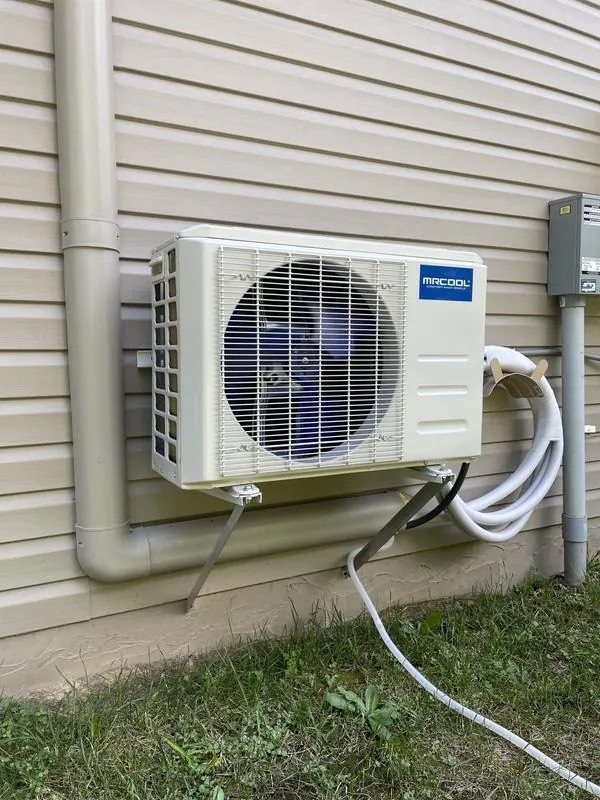
A real MRCOOL DIY install — wall-bracket condenser with the pre-charged quick-connect line set.
Performance
Performance, Efficiency & Comfort in Everyday Use
Real-world performance matters more than brochure numbers.
Cooling: An 18,000–24,000 BTU MRCOOL diy 4th can cool a 600–1,000 sq. ft. space quickly on a 90°F day when sized correctly. The unit can run steadily, reduce humidity, and keep temperature comfortable.
Heating: In 40–60°F weather, the 4th Gen usually performs well. Near 10–20°F, it may lose capacity and need backup heat. Heat pumps can operate efficiently in cold climates, but cold climate certification is important when the system is your main winter heat source. Some mini-split units operate in extreme cold conditions, and newer Zone Air systems are stronger here.
Bills: Replacing a 15-year-old 10 SEER unit with a 20.5 SEER MRCOOL in a 900 sq. ft. room can cut summer cooling use meaningfully, depending on insulation and climate.
Comfort: A wall-mounted fan distributes air from one side of the room, so layout matters. Zoning is the big benefit: you choose independent comfort per room instead of conditioning the whole house.
Noise: Indoors, expect quiet airflow on low and more noticeable sound on high. Outdoors, vibration can appear if the condenser is not on a solid pad or bracket.
Zone Air systems targeting up to 24 SEER2 are powered by newer design choices, better inspection, and stronger low-ambient heating. That makes them a better fit for northern U.S. and Canadian regions.
Reliability & Support
Reliability, Support, and How 4th Gen Compares to Newer Options
A heat pump should last 10–15 years, so reliability and support matter. MRCOOL 4th Gen compressors are generally solid, but reviews often mention leaking quick-connect fittings, communication errors, sensor faults, or delayed parts.
Older 4th Gen parts may become harder to source as MRCOOL prioritizes newer lines. That can make support harder if the reseller changes, the exact model is discontinued, or the warranty path is unclear.
Zone Air is different because USA-based assembly, testing, and inspection help catch issues before shipping. If you have questions, you can talk with a dedicated support team that knows the product line instead of bouncing between seller and manufacturer.
Pros of MRCOOL DIY 4th Gen
True DIY design
Established track record
Pre-charged lines
Good choice for moderate climates
Cons of MRCOOL DIY 4th Gen
Older R-410A technology
Remaining stock may be limited
Weaker cold-climate performance
More quality variation than Zone Air
DIY HVAC systems are beneficial for homeowners in moderate climates and seeking cost savings. Bargain hunters in mild areas may still choose a mrcool diy 4th gen unit if the price is low. But if you want better warranty clarity, fewer installation surprises, and long-term comfort, choose a newer Zone Air system.